
AI on the buy-side desk that an auditor will sign off on.
Self-hosted, Claude-backed pricing, risk, scenarios, and FIX-booked trades — fronted by a pure-function policy gate, a hash-chained audit log, and HITL approvals the agent cannot forge.
- AIGF v2.0
- 23 / 23 risks
- License
- MIT
- Audit
- Tier 3
FINOS AIGF v2.0
23 / 23 risks mapped
AIR-DET-21 audit
Tier 3 tamper-evident
License
MIT · self-hosted
Coverage gate
CI fails below 85%
Governance you can prove in a single SQL query.
Four primitives, designed so a stranger with subpoena power can verify the control claims in an afternoon.
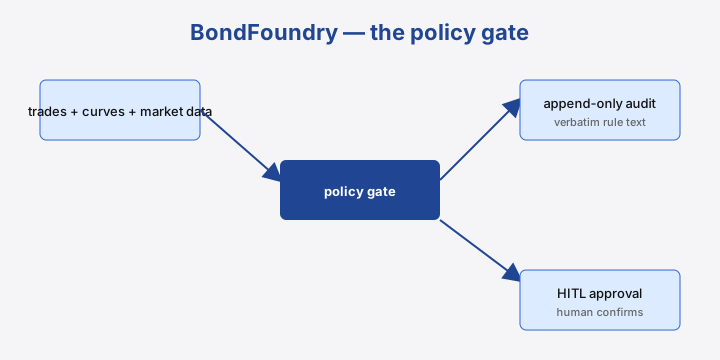
Policy gate
One pure function. Every action. Every time.
A single deterministic function every governed action passes through. No I/O, no state, no eventually-consistent guesswork. Tier-routed by reversibility, returns a verbatim rule citation on every blocked decision.
-
decide(action, context) → Decision -
Tiers T0 (read) · T1 (reversible) · T2 (single-HITL) · T3 (dual-HITL irreversible) -
Fuzz-tested across millions of synthetic actions
See the pillar
Audit chain
Append-only at the database. Hash-chained across rows.
Postgres triggers reject UPDATE and DELETE on the audit table — the application layer does not get a vote. Every row carries a sha256 hash over the previous row, so any insert between two rows breaks the chain in a single SQL query.
-
Postgres BEFORE UPDATE/DELETE triggers -
sha256 row chain for Tier-3 tamper-evidence -
framework_ref NOT NULL with taxonomy validation
See the pillar
HITL envelopes
HMAC-signed approvals the agent cannot forge.
When the gate routes an action to T2 or T3, the agent requests an envelope. The server signs it with a key the agent never sees, scoped to this exact ISIN, notional, and side. SoD is enforced at the API, not the UI.
-
HMAC-signed, server-generated, 90s expiry -
scope_hash binds approval to action + identity -
Distinct approver identity enforced at the API
See the pillar
AIGF coverage gate
23 of 23 risks mapped. CI fails below 85%.
Every PR runs the four-dimension eval harness and the AIGF coverage report. If coverage drops below 85% or any AIGF v2.0 risk has zero passing eval cases, the build fails. Continuous monitoring as CI.
-
Four dimensions: accuracy · policy · robustness · latency -
23 / 23 AIGF v2.0 risks mapped to code + eval + audit -
bondfoundry-finos coverage --threshold 0.85
See the pillar
Each role gets a different first conversation.
BondFoundry serves four audiences. Each landing page is written for what you actually need to evaluate.
Buy-side desk
PMs, traders, treasury
A Claude-backed analyst on your desk. Above-materiality trades never bypass you.
Book the desk walkthrough
Engineers & CTOs
Architects, platform leads
Fork-friendly governance primitives. Not another vendor lock-in.
Read the architecture
Quants & AI architects
Model evaluators, AI leads
A pure-function policy gate you can embed. A four-dimension eval you can extend.
See the eval harness
FINOS & compliance
Reviewers, risk officers
The first runnable AIGF v2.0 reference. 23 of 23 risks mapped.
Read the FINOS mapping
Where a governed agent earns its keep.
Four patterns, each grounded in shipped behaviour — the policy gate, HITL envelopes, the hash-chained audit log, and the AIGF coverage gate.
Materiality-gated trade execution
Let an AI agent draft fixed-income trades while every above-materiality order stops at an HMAC-signed HITL approval it cannot forge.
ReadTamper-evident audit for regulators
Give auditors a hash-chained, Postgres-enforced audit log where every AI decision maps to a FINOS AIGF v2.0 control.
ReadSegregation of duties for AI agents
Enforce four-eyes and dual-approval controls on an autonomous agent at the API layer — not the UI — so the agent can never self-approve.
ReadA runnable FINOS AIGF reference
Adopt or study a working reference implementation of FINOS AIGF v2.0 with 23 of 23 risks mapped to code, evals, and audit rows.
ReadFor the finance teams designing this from scratch.
Cornerstone pieces on auditable AI agents, materiality-tier routing, and the FINOS AIGF v2.0 control surface.
The Four Pillars of Governed AI in Finance
Policy gate, audit chain, HITL envelopes, and the AIGF coverage gate — the four primitives every agentic-AI system in a regulated workflow needs.
Open-Source vs Vendor SaaS: Building Your Own Governed AI Desk
Why self-hosting an AI agent for the buy-side desk is a board-level conversation in 2026 — and the fork-and-swap pattern that makes it tractable.
FIX Gateway as AI: Connecting Your OMS to Claude-Backed Quant Analysis
How BondFoundry's FIX 4.4 gateway sits in front of an AI agent — with HITL approval envelopes, ExecutionReport flowback, and a HITL queue that doesn't trust the model.
What teams ask before the first call
Is BondFoundry a replacement for Aladdin, SimCorp Dimension, Charles River, or Bloomberg AIM?
No. BondFoundry is designed to sit alongside whatever OMS or book-of-record a desk already runs. It is the AI agent layer with governance built in — not the OMS itself.
How is BondFoundry licensed?
MIT. The full source is on GitHub. You can fork it, self-host it, and modify it for your domain (loans, derivatives, etc.) without any commercial license.
What is the FINOS AI Governance Framework v2.0?
AIGF v2.0 is the FINOS-published taxonomy of 23 AI risks and 23 mitigations for agentic AI in financial services. BondFoundry is the working reference implementation: every risk has a mapped mitigation in code, every mitigation has at least one passing eval case, every audit row carries a framework_ref.
Do I need Anthropic Claude to run BondFoundry?
Claude is the reference model and what we use in the demo. The model boundary is a tool-call interface, so swapping in another frontier model is a configuration change — not a re-architecture.
How do I evaluate BondFoundry for my desk?
Start with `make demo` from the GitHub repo for a sixty-second Docker compose run, or book a twenty-minute walkthrough on /book to see the policy gate, HITL queue, and audit chain end-to-end.
Explore the rest of BondFoundry.
The context you need before a call — where it fits, what the terms mean, and who builds it.
How BondFoundry compares
Runs alongside your OMS; a different optimization target from LangChain and AutoGen — governance auditability, self-hosted, MIT-licensed, not a book-of-record.
ExploreGlossary
Plain-language definitions: policy gate, tier routing, HITL envelopes, hash chain, framework_ref, the coverage gate, and more.
ExploreAbout BondFoundry
What it is and is not, the MIT license, and the FINOS AIGF v2.0 reference implementation built by Neullabs.
ExploreMore on governance, licensing, and the model boundary in the full FAQ · or read how it works.
20 minutes. Policy gate, HITL queue, audit chain — end to end.
We'll run a $5M corporate-bond rebalance through the live system. You'll see the chain, the envelope, and the framework_ref column.